Showing posts with label emergent. Show all posts

Tuesday, March 20, 2012

Tradition: Foundation Stone or Rock of Sisyphus?

In my December post, I recounted the words of the now-retired Rector of St. Bartholomew's Church that the Episcopal Church has a "huge and nearly immovable weight of tradition" that often prevents it from adapting well or quickly to new realities. Last week, Archbishop of Canterbury Rowan Williams announced he was resigning to become head of Magdalene College at Cambridge. In a recent interview, Williams discusses tradition and the "fresh expressions of church" movement in England:
Remember, you're not the first people to read the bible. There's twenty centuries of people praying and thinking through scripture and passing on their wisdom. It would be wonderful if we could recover a really lively and positive sense of what tradition meant. Not this great weight pressing down on you---this is how we've always done it---but there's this great reservoir of experience and wisdom which we're free to draw on and grow with.

And I think that is one lesson that all new kinds of congregation[s] have to bear in mind. The more traditional, traditionally mainstream kinds of church, need to know that the church is always being restored and renewed from unexpected places. The new, renewing, bits of church need to remember that God has not abandoned His church over twenty centuries and has been giving gifts all the way through to learn from. So it's that balance, what I once called the "mixed economy" of the church, which I think keeps us fit.
That got me to thinking about the nature of tradition. On the one hand, it can and does form a solid foundation upon which to build. On the other hand, it can just as easily become the proverbial Rock of Sisyphus that folks get tired of moving.

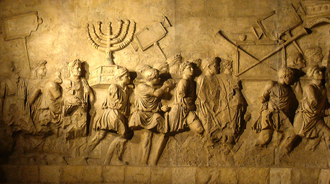
I think this has a lot to do with an emerging (no pun intended) idea that this post-Christian time period is much like the time after the destruction of the temple in Jerusalem in 70 A.D. We're in a post-establishment time and there is a huge temptation to metaphorically attempt to carry some of the foundation stones away from the now-destroyed temple in an attempt at reconstruction, or at least an attempt to hold onto a symbol of the way things used to be. Contrast that with Jesus' words about the temple that were read two Sundays ago:
Jesus answered them, "Destroy this temple, and in three days I will raise it up." The Jews then said, "This temple has been under construction for forty-six years, and will you raise it up in three days?" But he was speaking of the temple of his body." (John 2:18-21)
Jesus also famously said to his disciples, upon sending them out for the first time:
"You may take along a walking stick. But don't carry food or a traveling bag or any money. It's all right to wear sandals, but don't take along a change of clothes. When you are welcomed into a home, stay there until you leave that town. If any place won't welcome you or listen to your message, leave and shake the dust from your feet  as a warning to them." (Mark 6:8b-11)
I'm just beginning to unpack the metaphor of the similarities between post-temple Judaism and post-Christendom Christianity, but the lesson for us may be to be quite careful about what we choose to put in our "tradition packs." When I was a child, our family used to take backpacking trips regularly. When one backpacks, the object is to make things as light as possible, since you are going to be carrying anything you pack for many miles. So, things are re-packaged to minimize weight, one makes use of freeze-dried foods that are much lighter than regular food, and one is very careful about what sort of "extras" one takes--and things that seem critical in regular camping, not to mention around the house, rapidly become "extras" when one is forced to carry them for many miles on one's back!

Perhaps that is what we're doing these days in the church--we're packing for an ecclesiastical backpacking trip. We're trying to sort our the essentials from the extras--and sometimes finding out that things that seemed essential when we were in the comforts of Christendom have become extras now that we are packing for a trip into the ecclesiastical and spiritual wilderness. Perhaps we also need to unload and drop our temple building-stones and recall that Jesus is talking about himself when he says:
 "Then what do the Scriptures mean when they say, `The stone that the builders tossed aside is now the most important stone of all'? Anyone who stumbles over this stone will get hurt, and anyone it falls on will be smashed to pieces." (Luke 20:17b-18)
Pack carefully....

Saturday, July 11, 2009

General Convention, Day Four

Got up a litle earlier this morning and was present when the House of Deputies went into session at 9:30 a.m. I continue to have the rather cynical sounding question reverberating in my mind: Why so huge and cumbersome a legislative process for a church of slightly over two million members? There is a plea from the Program, Budget, and Finance Committee for both creative and realistic ways of plugging what is likely to be a $15 million income shortfall. I have a solution: Cut the budget, do fewer things, and focus on what we can and are called to uniquely do. I'm also struck by how glacially slow it seems things get done. Presumably the pace will accellerate as legislative committees complete their work and the end of Convention nears, but I frankly almost feel sorry for the Deputies, at least, spending hour after hour plodding through resolution after resolution, any one of which might well be spoken to by at least one person for several minutes. With hundreds of resolutions, it will be a very long remainder of Convention!

After ducking out of the House of Deputies meeting I headed for the daily Community Eucharist where I was asked to be one of the distributors of bread. Though clad in a t-shirt and slacks rather than a nicer outfit, I agreed. After all, how often does one get to distribute bread at a General Convention Eucharist? It was very fun, not least because my friend Maureen was the Deacon in charge of that communion station and the altar guild person there was someone I knew from long ago in the Diocese of California. I really liked the variety of people that came to me for bread--bishops, visitors, young, old, the whole diversity of the Episcopal Church, in fact! Perhaps the most fun, however, was giving communion to the children in the children's choir after they sang. WOW! It was like feeding pigeons--they all wanted a piece of bread, and all at once. It was actually pretty darn exciting. I don't think I've given that many children communion at one service in the entirety of my ordained ministry. Very cool.

After that, I headed for the NNECA (National Network of Episcopal Clergy Associations) lunch, which I thought I'd registered and paid for, but they didn't have my name on the list. So, I sat in back and participated as much as seemed needed. I did split a wrap (sandwich) with one of my seminary classmates (she could only eat half anyway, she said), so I got some food. The Rt. Rev. Eugene Sutton, Bishop of Maryland, was the keynote speaker. He talked about a time when Peter Drucker (of Seven Habits of Highly Effective People fame) filled a bucket with large rocks. He asked the audience if the bucket was full. They said "yes." He then proceeded to pour some gravel in the bucket, filling it with gravel. He asked again if the bucket was full. His audience again replied "yes," but with much less force. He then poured a load of sand in the bucket, again filling it. Once again he asked if the bucket was full. By then there was a definite questioning "yes?" He poured a pitcher of water in, and the bucket was full.

The moral of the story, far from what I thought it might be ("nothing is what it seems" or "there's always room for more," or something equally obvious) was instead "you have to get the rocks in first, otherwise you'll never get them in." He said his rocks were Prayer, Holiness, Purpose, Discipline, and Honor. If you don't get those in your life, he said, everything else fills it up and you can't get that in. He used the example of prayer, which was a great one for me as that sometimes really does slip out of my day without my really knowing or intending it. All in all, an excellent experience.

Following that, both Houses began a marathon 2:30 to 6 p.m. legislative session. I poked into the House of Deputies, heard a few presentations regarding the debate on resolution 2006-B033, but decided to duck out after a half-dozen. It will be interesting to see what General Convention does with the various resolutions having to do with sexuality. Some are direct repeals of B033, others seek to clarify our canons with regard to qualifications for ordination (heterosexuality specifically isn't one), and still others are either canonical changes or changes of policy that would permit some form of same-sex blessings (which B033 doesn't address). It will be interesting to see how all of those resolutions make it through the various legislative committees and which ones make it through which House(s).

I spent from 3 to 4 p.m. saying afternoon prayers (at 3 p.m.) and watching the booth in the exhibition hall which functions as the Convention Chapel. Why the General Convention doesn't have an actual Convention Chapel is beyond me, but they don't. Anglimergent, a group of emergent Anglican folks, solicited donations and put this together. We had four of us for afternoon prayers. Many people walked by and said something like "it's great that this is here" or "what a good idea" but none stopped to actually make use of the space. The cynical part of me thought that was just like some church folks--they want to know that a program is there, even if they don't intend to use it!

Did a little looking around the exhibit hall, walked the 20 minute walk back to my hotel, remembered I was due to go to a CREDO reception, and walked nearly all the way back to the convention center. After the reception I walked back to my hotel and grabbed the shuttle for Downtown Disney. It was fun to wander, but apart from grabbing a late dinner and a hat with Mickey ears, I didn't really buy anything. Now I sit in my room as it approaches 1 a.m. and wonder what I'll do tomorrow. I might possibly try to get to the morning legislative session again (at 9:30 a.m.) or, if I'm feeling particularly lazy, I'll aim for the 11:30 a.m. Eucharist. Since it is my last full day at General Convention (I leave Sunday afternoon), it will likely be the former, or at least arriving early enough to do some shopping before the Eucharist. Until later today...

Wednesday, March 25, 2009

Beyond Modernity: Episcopal Evangelism

There is an excellent presentation by Brian McLaren: the keynote address for the Diocese of Washington (DC). It is well worth watching, but I include his talking points below to wet your appetite.

In his presentation he mentions four advantages that Episcopalians have in the twenty-first century. They are:

1) A "Via Media" Mindset: Many Anglicans never surrendered to the modern mindset.
2) A Celtic Mindset: We have vestiges of non-Roman Christianity in our makeup.
3) A Diverse Mindset: We give people space to differ in their opinions.
4) A Liturgical Mindset: Space to experience God, bonding to meaning, beauty of worship, participatory.

He also notes some disadvantages:

1) An Upper Class Mindset: Elitist, "civilized", older, one-size fits all.
2) An Institutional Mindset: Centralized, controlled, change-resistant, risk averse, bureaucratic -- averse to charismatic leaders.
3) A Christendom Mindset: Parish/geography, people ought to come to us.
4) A Bi-polar Mindset: Cold war liberal-conservative.

He goes on to suggest some things that are needed:

1) A "bring them in" spirit (not merely welcoming within a caste): Diversity, innovation, welcoming all seekers (especially the young!), inviting friends, relatives, associates, neighbors. Question: What would it take for you to be excited about inviting your friends to church? What embarrasses or concerns you?

2) A "let's experiment" spirit (not institutional): Entrepreneurial, self-organizing, evolutionary, experimental--adding experiments (for 4 to 8 weeks), adding new services, planting new congregations (inside existing?), adding new models or examples (Fresh Expressions, Anglimergent?).
Question: Who says "no" to new ideas? Who can say "yes"? Who can bring new ideas?

3) A "we're beginning again" spirit (renewing, not conserving, a history): Demography, adaptive, agile--a huge rummage sale "What needs to be put on the curb?", getting rid of the junk in "cleaning house", changes in physical, social, and/or spiritual architecture.
Question: Would you rather be motivated by desperate necessity or surging creativity? What would your church look like if it could seize the possibility of a total makeover?

4) A "transcend and include" spirit (above liberal and conservative): Where is the via media? Which future do you prefer (conservative, liberal, centrist, or transcendent inclusive)?

...and

5) The Holy Spirit! People aren't seeking religion, they are seeking spirituality. You can't give what you don't have (you have to smoke what you're selling). People need to experience God, worship, transformation, belonging, participation in God's creative and healing mission in our world...
Question: Are you eager to become a "sample" of what God wants to do in the lives of others?

McLaren goes on to cast a vision for the church as a collection of individuals in partnership with God for the transformation of the world. I'll let you listen to the talk for specifics, but this sounds like a mission that the Episcopal Church, as a incarnation-centered, socially active, and spiritually rich church could really get behind!