This morning I awoke to the happy news that my article with profiles of all four candidates for Presiding Bishop of The Episcopal Church has been published online and will soon appear in print in the June 6 issue of The Living Church. Having done profiles of two candidates in advance of the last election nine years ago (including one of Katherine Jefferts Schori, the eventual selection) I was pleased to be asked to do profiles of all four candidates this time.
As I noted in my article, we are in a very different era than we were in 2006--especially as far as the number and variety of information sources available to us. In 2006 the iPhone had not been announced and Twitter, Facebook, and YouTube were in their infancy. Now, in only a few clicks, one can have more than enough information about the candidates as well as the General Convention as a whole. Scott Gunn has provided an excellent summary of the reports and resolutions of General Convention in his series of articles. Others have provided their own commentary, including an excellent series from Susan Snook in her blog and via the Acts 8 Moment group she helps lead. Speaking of the Acts 8 Moment, there is also the related Memorial to the Church at the newly-created Episcopal Resurrection site.
We are now less than one month away from the 78th General Convention of the Episcopal Church and, as you can well imagine, there are fast and furious discussions going on the House of Deputies and Bishops email list, the General Convention Facebook group, and via innumerable blogs. This coming convention promises to either be a transformational moment in which The Episcopal Church institutionally breaks itself open to facilitate more effective mission and ministry in the twenty-first century or the biggest disappointment in recent memory as the energy behind the near-unanimous vote for restructuring the Episcopal Church dissipates amid the realities of parochialism and turf wars. Bishop Andy Doyle has blogged about our human tendency towards limited vision here and I hope we are able to rise above such tendencies and truly position the church for twenty-first century ministry. We shall see.
The thoughts of a Generation X Episcopal Priest. As I strive to be a faithful Christian, husband, father, and priest in The Episcopal Church, this serves as an account of my thoughts, experiences, and opinions. The opinions expressed are, of course, my own. Respectful responses are welcome.
Showing posts with label change. Show all posts
Friday, May 29, 2015
Saturday, January 03, 2015
Being Offended vs. Being Concerned
I recently ran across this image (from Sue Fitzmaurice) which sums up a number of thoughts I've been having over the past few months regarding how easily we are "offended" at things and how few times that offense is translated into meaningful action. The Internet (and, more specifically, Facebook) allows the spreading of information, images, and opinions with a few clicks. Once we've done that, we can go on about our normal day. Some of these posts and articles we pass on are written specifically to elicit such clicks--they are designed to stimulate us to pass them along.
I wonder: What if we committed to not passing along anything we aren't personally committed to doing something about? Doing something beyond passing the information along, I mean. It is easy for me to read an article and, with a few clicks, drop it into my Facebook feed for all of my friends to see and pass along. While there is some value in making people aware of instances of poverty, injustice, greed, and violence, perhaps we should see that as a first step in addressing those issues, not the last.
Something to think about in this new year.
I wonder: What if we committed to not passing along anything we aren't personally committed to doing something about? Doing something beyond passing the information along, I mean. It is easy for me to read an article and, with a few clicks, drop it into my Facebook feed for all of my friends to see and pass along. While there is some value in making people aware of instances of poverty, injustice, greed, and violence, perhaps we should see that as a first step in addressing those issues, not the last.
Something to think about in this new year.
Thursday, July 24, 2014
Money as Fuel and the Why of What We Do
"In bad, unhealthy cultures, money is the goal....The great organizations, the great leaders, see money as a tool to further fuel whatever it is they are building. Of course they want financial success, because the more money they have. the more that they can protect their people....They see money as fuel, not as a destination." -- Simon SinekOne of the great things about a sabbatical is not simply that one gets to go to a conference or seminar just because one is curious about it, but the fact that there is time to simply explore ideas. A couple of years ago, I ran across Jonathan Fields' Good Life Project, a video series of conversations with creative and interesting people. The above quote came from a recent conversation with Simon Sinek, where he talks about the power of serving others and fostering a corporate culture of safety so that people feel free to risk without reprisal if their idea or project fails.
He makes a comparison between General Electric, which was led by Jack Welch and focused on maximizing shareholder value, even to the extent of laying off people who didn't sufficiently contribute to the bottom line, and Costco, whose founder Jim Sinegal, set up a culture that pays workers well and values them. He noted that while the stock price of GE fluctuated wildly since 1986 when Costco went public, over the long-term one would have realized a 600% return on GE stock and a 1200% return on Costco stock if one sold each today. His point is that if you aim for wealth, you fail. If you aim for service, you win.
I've been thinking about how one might apply that to the church. In a TED talk he gave, Simon talks about the fact that people buy the "why" of what you do rather than the "what" that you are selling. In other words, people buy into the dream that is promised, not the product that is produced. We talk an awful lot about "stewardship" in the church--encouraging, almost demanding, that people give money to the church as a spiritual exercise. But in spite of that at least annual exhortation, people generally give the same amount--and it is generally anywhere from 1 to 2 percent of their income rather than the 10 percent tithe that is the "minimum standard of giving" in the Episcopal Church. Why? I suspect it is because we focus on all of the "products" (programs, worship, etc...) we are producing and not on why we are doing what we are doing. What is the dream into which we are inviting people to literally buy? If it is "keep the clergy employed, the lights on, and the services going," that isn't very compelling.
If, however, Good Samaritan Episcopal Church, and other churches, can make a compelling case for why we do what we do, and can care for people to such an extent that they will feel safe venturing out in faith, trust will naturally be built and presumably people will be willing to extend themselves both financially and physically in service to that dream. It then ceases to be about money and becomes a question of whether we have enough "fuel" to do the things that God has called us to do. Just like fuel for a car, everyone knows that the church needs money in order to do the things that God has called us to do, even in order to survive to do those things. Like a car, however, the question of where we are going with the full tank of gas that we have is an important one, especially if there is an expectation that our tank will be repeatedly refilled. People who give to churches rightly expect to know where the church is going and what the church is doing. However, they want to know even more what the dream is--what is the vision of the future toward which we aspire? That is the task before the Vestry and the clergy in the coming months and years: to define the dream.
Labels:
change,
Good Life Project,
money,
motivation,
sabbatical,
vision
Monday, July 30, 2012
Money, Politics, and the Race to the Bottom
I don't usually get too political on this blog, but I just received an email, ostensibly from Vice President Joe Biden (but really from the Obama campaign) with a message that made me sit up, take notice, and sigh deeply. The message was this:
"If we don't win this election, it will be because we didn't close the spending gap when we could."
Really? Has our nation become so politicized, so polarized, so shallow, that the Presidential election will be decided solely by who has raised the most money? If that's the case, couldn't we at least do it for a worthy cause--sort of like Presidential telethon for, say, cancer. The one who raises the most money for the cause wins the election. At least then it wouldn't be literally billions of dollars spent on increasingly negative ads tearing down the other candidate and distorting his or her words and/or record. Perhaps I'm neither naive or just idealistic, but I would hope that the reason anyone loses an election is that the ideas and policies put forth by him or her at least seem better than the ideas and policies put forth by his/her opponent. Period.
I'm pretty tired of the zero-sum political game--every policy question is framed in terms of who "wins" and who "loses." Even some TED talks are being restricted because tax policy is deemed "too political." Check this one, for instance:
This is a person who has "been there and done that" as far as starting a business, and has been extremely successful doing so. Yet his testimonial is deemed "too political" in the current environment.
I long for a day in which people argue policy questions and come to a compromise solution that is good for the country. As long as we vote for whoever comes out on top of the fundraising smackdown, everyone loses.
Thursday, April 19, 2012
From Assembly Line to Artisan
I am a huge fan of RSA, and more specifically the RSAnimate video series. Recently, I ran across a great video from 2010 discussing the huge challenges facing education in the twenty-first century. Check it out here:
I think the author, Sir Ken Robinson, makes some excellent points. I began formal schooling nearly 40 years ago. When I began, we did do a lot of playing, interacting with the world, and (yes) learning in the process. Fairly quickly, however, we ended up in a classroom with rows of desks, teachers in front of blackboards, heavy textbooks which we were not permitted to write in, and, increasingly, being taught subjects we had no interest in and many of which seem to have no practical application. So, now my children are in school and what fantastic progress has been made in almost 40 years? Well, there is more "group work" and children sitting in "pods" of four to six children (which has its own problems for those of us who are introverts, as this video points out). There certainly are more computers, smart boards, and other technology. White boards with pens have replaced blackboards with chalk. There is a lot more standardized testing.
Aside from all of that, kids are still being stuffed into classrooms with teachers in front of white boards, taught subjects of questionable utility from heavy textbooks (which they're still prohibited from writing in) and penalized if they don't find this as scintillating as conversations with one another or staring out the window, of which there are increasingly few. The comparison to a factory churning out groups of standardized students made in the video is painfully apt. We appear to be doing almost exactly the same teaching, with some technical modifications and "improvements" as we did four decades ago.
That lack of progress would be enough of a tragedy, but it is compounded by the fact that the world in which we are training our children to take their place as contributing citizens not only will not exist when they graduate, it does not exist now. We live in a hyper-networked world where I can more easily contact someone halfway around the world than I can run down the hallway and see them face-to-face. We have access to more information in less time than anyone in human history. The speed of innovation is increasing exponentially--and our institutions and infrastructure are imploding.
From politics, to nonprofits, to corporations, and even to the church, institutions that launched the Baby Boomers into the world as arguably the most successful generation in history are crumbling in the face of a lack of common purpose, a lack of money, and a lack of a compelling rationale for their continued existence. Rather than seizing this opportunity to re-make the world with the revolutionary fervor of the 1960s, most of those Boomers and Xers in power are fighting a doomed fight to preserve what can be preserved of what was. And, sadly, they are being rewarded for doing so by constituents and consumers in a sort of "race to the bottom."
The solution is easy to say and difficult to implement--primary because it requires qualities that our parents and grandparents had but which seem increasingly in short supply: sacrifice and courage. We need to acknowledge the reality that some long-cherished things are dead or in their final stages of life. We need to think creatively about how to re-make the United States as a successful twenty-first century country in a twenty-first century world, and we need to reward politicians and corporate leaders for truth-telling and courageous leadership rather than for telling us what we want to hear. And we need to do this now, before a generation or two of people emerges that are ill-equipped to deal with twenty-first century realities and can only watch helplessly as things (sometimes literally) sink beneath the waves. It is also going to require that we recognize that the world has moved from the assembly-line back to the artisan, the craftsman, this time in the craftsmanship of the mind. We need to reward and enhance creative thinking rather than penalizing it--because we can't keep doing what we've been doing for the last half-century.
I think we can do all of this, but it is going to require us to resist easy answers, to know that the economic party of the 1990s and 2000s is over, and begin the make the adaptive changes needed rather than simply doing some technical tweaking.
Here ends the sermon.
I think the author, Sir Ken Robinson, makes some excellent points. I began formal schooling nearly 40 years ago. When I began, we did do a lot of playing, interacting with the world, and (yes) learning in the process. Fairly quickly, however, we ended up in a classroom with rows of desks, teachers in front of blackboards, heavy textbooks which we were not permitted to write in, and, increasingly, being taught subjects we had no interest in and many of which seem to have no practical application. So, now my children are in school and what fantastic progress has been made in almost 40 years? Well, there is more "group work" and children sitting in "pods" of four to six children (which has its own problems for those of us who are introverts, as this video points out). There certainly are more computers, smart boards, and other technology. White boards with pens have replaced blackboards with chalk. There is a lot more standardized testing.
Aside from all of that, kids are still being stuffed into classrooms with teachers in front of white boards, taught subjects of questionable utility from heavy textbooks (which they're still prohibited from writing in) and penalized if they don't find this as scintillating as conversations with one another or staring out the window, of which there are increasingly few. The comparison to a factory churning out groups of standardized students made in the video is painfully apt. We appear to be doing almost exactly the same teaching, with some technical modifications and "improvements" as we did four decades ago.
That lack of progress would be enough of a tragedy, but it is compounded by the fact that the world in which we are training our children to take their place as contributing citizens not only will not exist when they graduate, it does not exist now. We live in a hyper-networked world where I can more easily contact someone halfway around the world than I can run down the hallway and see them face-to-face. We have access to more information in less time than anyone in human history. The speed of innovation is increasing exponentially--and our institutions and infrastructure are imploding.
From politics, to nonprofits, to corporations, and even to the church, institutions that launched the Baby Boomers into the world as arguably the most successful generation in history are crumbling in the face of a lack of common purpose, a lack of money, and a lack of a compelling rationale for their continued existence. Rather than seizing this opportunity to re-make the world with the revolutionary fervor of the 1960s, most of those Boomers and Xers in power are fighting a doomed fight to preserve what can be preserved of what was. And, sadly, they are being rewarded for doing so by constituents and consumers in a sort of "race to the bottom."
The solution is easy to say and difficult to implement--primary because it requires qualities that our parents and grandparents had but which seem increasingly in short supply: sacrifice and courage. We need to acknowledge the reality that some long-cherished things are dead or in their final stages of life. We need to think creatively about how to re-make the United States as a successful twenty-first century country in a twenty-first century world, and we need to reward politicians and corporate leaders for truth-telling and courageous leadership rather than for telling us what we want to hear. And we need to do this now, before a generation or two of people emerges that are ill-equipped to deal with twenty-first century realities and can only watch helplessly as things (sometimes literally) sink beneath the waves. It is also going to require that we recognize that the world has moved from the assembly-line back to the artisan, the craftsman, this time in the craftsmanship of the mind. We need to reward and enhance creative thinking rather than penalizing it--because we can't keep doing what we've been doing for the last half-century.
I think we can do all of this, but it is going to require us to resist easy answers, to know that the economic party of the 1990s and 2000s is over, and begin the make the adaptive changes needed rather than simply doing some technical tweaking.
Here ends the sermon.
Labels:
change,
culture,
transformation,
transition
Tuesday, March 20, 2012
Tradition: Foundation Stone or Rock of Sisyphus?
In my December post, I recounted the words of the now-retired Rector of St. Bartholomew's Church that the Episcopal Church has a "huge and nearly immovable weight of
tradition" that often prevents it from adapting well or quickly to new realities. Last week, Archbishop of Canterbury Rowan Williams announced he was resigning to become head of Magdalene College at Cambridge. In a recent interview, Williams discusses tradition and the "fresh expressions of church" movement in England:
I think this has a lot to do with an emerging (no pun intended) idea that this post-Christian time period is much like the time after the destruction of the temple in Jerusalem in 70 A.D. We're in a post-establishment time and there is a huge temptation to metaphorically attempt to carry some of the foundation stones away from the now-destroyed temple in an attempt at reconstruction, or at least an attempt to hold onto a symbol of the way things used to be. Contrast that with Jesus' words about the temple that were read two Sundays ago:
Perhaps that is what we're doing these days in the church--we're packing for an ecclesiastical backpacking trip. We're trying to sort our the essentials from the extras--and sometimes finding out that things that seemed essential when we were in the comforts of Christendom have become extras now that we are packing for a trip into the ecclesiastical and spiritual wilderness. Perhaps we also need to unload and drop our temple building-stones and recall that Jesus is talking about himself when he says:
Remember, you're not the first people to read the bible. There's twenty centuries of people praying and thinking through scripture and passing on their wisdom. It would be wonderful if we could recover a really lively and positive sense of what tradition meant. Not this great weight pressing down on you---this is how we've always done it---but there's this great reservoir of experience and wisdom which we're free to draw on and grow with.That got me to thinking about the nature of tradition. On the one hand, it can and does form a solid foundation upon which to build. On the other hand, it can just as easily become the proverbial Rock of Sisyphus that folks get tired of moving.
And I think that is one lesson that all new kinds of congregation[s] have to bear in mind. The more traditional, traditionally mainstream kinds of church, need to know that the church is always being restored and renewed from unexpected places. The new, renewing, bits of church need to remember that God has not abandoned His church over twenty centuries and has been giving gifts all the way through to learn from. So it's that balance, what I once called the "mixed economy" of the church, which I think keeps us fit.
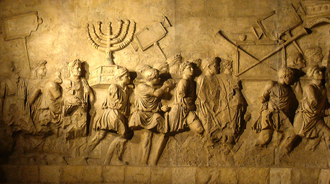
I think this has a lot to do with an emerging (no pun intended) idea that this post-Christian time period is much like the time after the destruction of the temple in Jerusalem in 70 A.D. We're in a post-establishment time and there is a huge temptation to metaphorically attempt to carry some of the foundation stones away from the now-destroyed temple in an attempt at reconstruction, or at least an attempt to hold onto a symbol of the way things used to be. Contrast that with Jesus' words about the temple that were read two Sundays ago:
Jesus answered them, "Destroy this temple, and in three days I will raise it up." The Jews then said, "This temple has been under construction for forty-six years, and will you raise it up in three days?" But he was speaking of the temple of his body." (John 2:18-21)Jesus also famously said to his disciples, upon sending them out for the first time:
"You may take along a walking stick. But don't carry food or a traveling bag or any money. It's all right to wear sandals, but don't take along a change of clothes. When you are welcomed into a home, stay there until you leave that town. If any place won't welcome you or listen to your message, leave and shake the dust from your feet as a warning to them." (Mark 6:8b-11)I'm just beginning to unpack the metaphor of the similarities between post-temple Judaism and post-Christendom Christianity, but the lesson for us may be to be quite careful about what we choose to put in our "tradition packs." When I was a child, our family used to take backpacking trips regularly. When one backpacks, the object is to make things as light as possible, since you are going to be carrying anything you pack for many miles. So, things are re-packaged to minimize weight, one makes use of freeze-dried foods that are much lighter than regular food, and one is very careful about what sort of "extras" one takes--and things that seem critical in regular camping, not to mention around the house, rapidly become "extras" when one is forced to carry them for many miles on one's back!
Perhaps that is what we're doing these days in the church--we're packing for an ecclesiastical backpacking trip. We're trying to sort our the essentials from the extras--and sometimes finding out that things that seemed essential when we were in the comforts of Christendom have become extras now that we are packing for a trip into the ecclesiastical and spiritual wilderness. Perhaps we also need to unload and drop our temple building-stones and recall that Jesus is talking about himself when he says:
"Then what do the Scriptures mean when they say, `The stone that the builders tossed aside is now the most important stone of all'? Anyone who stumbles over this stone will get hurt, and anyone it falls on will be smashed to pieces." (Luke 20:17b-18)Pack carefully....
Labels:
change,
church,
emergent,
leadership,
postmodern,
tradition
Thursday, January 26, 2012
Maintenance, Mission, and Ministry
I just watched a video greeting (via Episcopal Cafe) by Presiding Bishop Katherine Jefferts Schori, ostensibly to the deputies to General Convention 2012, but is useful for everyone to begin to think and pray about what sorts of structures are useful in nurturing mission and ministry in our multicultural, postmodern context and which are either less useful or, worse, actually choke off the Spirit's work in and through us.
I'm glad that we're having this conversation. While I don't think maintenance and mission are mutually exclusive, a balance between the two would seem a necessary prerequisite to effective ministry in today's fluid and networked world. I am aware, however, that there is a temptation to overcompensate by simply getting rid of nearly all structures in the name of freedom of ministry. I don't really think that is a great idea, either. The Episcopal Church has a sense of order and a Benedictine value of stability within its DNA. While some of the structures might tend to be stifling, other (such as the ordination and disciplinary canons mentioned in the video) have their place if properly applied. I don't think anyone wants to go back to the days when the "ordination process" was merely a nice chat with one's bishop, with little involvement from others nor a disciplinary process that involved an uncomfortable conversation with that same bishop and then a quiet resolution to the issue. Generally transparency and communal discernment are to be commended.
That said, it makes complete sense to ask the question: "Why are we spending over half of our financial resources keeping the structures functioning?" Some of the reason is provincial--no one wants to have their department cut or committee dissolved and there is some concern that a leaner church structure is also a less democratic one. I'm not quite sure that democracy is a Gospel or biblical value, but even if it is, a denomination with less than 2 million people that has a legislature larger than the United States congress that meets every three years for a marathon legislative session seems more than a little out of balance to me.
I'm not a deputy to General Convention. I am a member of our own diocesan Standing Committee, and we also are asking questions about the structure and purpose of various ways of doing things. Like cleaning out closets, it will be an interesting process of deciding what to keep, what to throw away, and what to re-purpose.
I'm glad that we're having this conversation. While I don't think maintenance and mission are mutually exclusive, a balance between the two would seem a necessary prerequisite to effective ministry in today's fluid and networked world. I am aware, however, that there is a temptation to overcompensate by simply getting rid of nearly all structures in the name of freedom of ministry. I don't really think that is a great idea, either. The Episcopal Church has a sense of order and a Benedictine value of stability within its DNA. While some of the structures might tend to be stifling, other (such as the ordination and disciplinary canons mentioned in the video) have their place if properly applied. I don't think anyone wants to go back to the days when the "ordination process" was merely a nice chat with one's bishop, with little involvement from others nor a disciplinary process that involved an uncomfortable conversation with that same bishop and then a quiet resolution to the issue. Generally transparency and communal discernment are to be commended.
That said, it makes complete sense to ask the question: "Why are we spending over half of our financial resources keeping the structures functioning?" Some of the reason is provincial--no one wants to have their department cut or committee dissolved and there is some concern that a leaner church structure is also a less democratic one. I'm not quite sure that democracy is a Gospel or biblical value, but even if it is, a denomination with less than 2 million people that has a legislature larger than the United States congress that meets every three years for a marathon legislative session seems more than a little out of balance to me.
I'm not a deputy to General Convention. I am a member of our own diocesan Standing Committee, and we also are asking questions about the structure and purpose of various ways of doing things. Like cleaning out closets, it will be an interesting process of deciding what to keep, what to throw away, and what to re-purpose.
Labels:
change,
diocese,
General Convention,
TEC,
transformation,
transition
Tuesday, December 13, 2011
Building a Legacy vs. Leaving a Legacy
The Rev. Bill Tully, Rector of St. Bartholomew's Church (where Julie Nelson, St. Edward's Priest Associate for Evangelism, once served) has written an excellent article in the Washington Post. Among his many keen observations, Bill stays this:
I have no real interest in leading The Church of What's Happening Now--a place that uncritically reacts to the current fashion and "felt needs" of the surrounding culture. Just troll around the Internet and you'll find a whole range of programs that are guaranteed to grow churches. In contrast to fashion, tradition is an excellent anchor in the midst of a cultural storm, holding us fast to the things that are important. However, tradition in and of itself is not enough. Tully goes on to say:
Episcopalians are the ultimate and extreme “legacy church.” No matter how committed the local rector is to change, no matter how deft she or he is in managing it, there is a huge and nearly immovable weight of tradition. Some of it is so good that it might--rightly reinterpreted and freshened--be the way forward to real growth in size and health. But it takes a lot of energy. We almost inevitably tilt backward for every step and a half we take forward.I would very much agree. The very thing that is the most distinctive about the Episcopal Church--our stability--is also what makes it difficult for us to change. I've likened the Episcopal Church to a battleship or an aircraft carrier: incredibly difficult to sink, but also very difficult to turn! Unfortunately, the navy stopped making battleships years ago and the only thing that keeps aircraft carriers from going the same way is that they carry nimble and highly mobile aircraft. To continue the metaphor, evangelical mega-churches are aircraft carriers, Episcopal congregations are battleships. Both exist in an era when fast patrol boats seem much more suited to the way things need to be.
I have no real interest in leading The Church of What's Happening Now--a place that uncritically reacts to the current fashion and "felt needs" of the surrounding culture. Just troll around the Internet and you'll find a whole range of programs that are guaranteed to grow churches. In contrast to fashion, tradition is an excellent anchor in the midst of a cultural storm, holding us fast to the things that are important. However, tradition in and of itself is not enough. Tully goes on to say:
Bishop Budde of Washington is absolutely right about concentrating on the meat and potatoes of local congregational life: worship, music, compelling preaching, education, pastoral care. Taking stands on issues at the national level (where few people pay attention to us any longer) might be satisfying, but we’ve just about spent ourselves doing that.That's what we're in the process of re-creating at St. Edward's: a place with vibrant worship, quality music, compelling preaching, a variety of educational offerings, and many ways of caring for others and being cared for as well. That kind of tradition is worth building on! The difficulty lies when we concentrate so much on leaving a legacy for "future generations" that we end up building and sustaining museums of ancient faith rather than concentrating on building a legacy alongside those right outside our doors that may not worship in the same way we are used to doing, but have a deep (perhaps even unnoticed) love of ritual, a more progressive theology, and a need for community. Building is challenging, but do-able!
Labels:
change,
evangelism,
teaching,
TEC,
tradition
Wednesday, August 24, 2011
Back to blogging: Ecclesiastical Antibodies
After essentially taking the summer off from blogging, I'm back with fingers to keyboard. As Summer turns to Fall, I've been thinking a lot about change. At St. Edward's, where I continue to serve as Priest-in-Charge, we've absorbed more than our fair share of changes in my almost two years here. What is interesting is looking at corporations who also are confronted with such changes.
In an article today by Philip Elmer-Dewitt, he talks about a recent podcast by Horace Dediu. In the article, Elmer-Dewitt quotes Dediu as saying the following:
What this says to me in my ministry is that if I want to be a church leader that fosters and nurtures innovation, I have to be willing to protect it from ecclesiastical antibodies. I also have to be willing and strong enough to at least make the attempt to maintain what is and what may be its polar opposite in the same organization, the church. I think I'll sit with that for a while. This is even more timely on the recent news that Steve Jobs has resigned as CEO of Apple.
In an article today by Philip Elmer-Dewitt, he talks about a recent podcast by Horace Dediu. In the article, Elmer-Dewitt quotes Dediu as saying the following:
There's a phrase I like to use: "the corporate antibodies." These are things inside the company, as an organism, if you will. These are entities -- be they people or budgets or processes or rules in binders. These are things that are designed to eat up innovation. To eat up changes to the core business. Not because they are stupid. But they see this newcomer, this entrant, as a pathogen. As something that's damaging the organism. So they act, sometimes even collude, to destroy it.Dediu goes on to draw a contrast between computer giant Hewlett-Packard (which recently gave up on its tablet computer and signaled that it is getting out of the PC market as well) and Apple (maker of the most popular tablet computer). Dediu's point, reiterated by Elmer-Dewitt, is that for innovation to take hold in an organization, the people promoting it have to be protected from the "corporate antibodies" that are out to destroy them, preferably protected by the CEO him/herself. Jobs tried to do that with the Macintosh, and was forced out of Apple by the "Apple II" forces. As fascinating as this is, one quote of Dediu at the end of the article really caught my eye:
[A certain innovation needed] this kind of champion at the very highest levels, someone who could endure the gestation for a long period of time. And that type of person is so rare as a CEO. Which is part of the mystique and magic of Steve Jobs. He's the only one that we know of really that is able to do these types of schizophrenic things -- like maintain a sustaining business and its disruption within the same organization."Maintain a sustaining business and its disruption within the same organization." When I read that, it suddenly struck me: "That's what we are trying to do in the church!" We're trying to respond to the needs of a post-Christian world with new and innovative things that, more often than not, get "killed off" by "ecclesiastical antibodies" trying to preserve our "sustaining business." Developing something new alongside that, often referred to as "parallel development" is, in reality, trying to "maintain a sustaining business and its disruption within the same organization." That's really hard to do! The fact that one of the most compelling images of the church is the Body of Christ makes this metaphor even more apropos!
What this says to me in my ministry is that if I want to be a church leader that fosters and nurtures innovation, I have to be willing to protect it from ecclesiastical antibodies. I also have to be willing and strong enough to at least make the attempt to maintain what is and what may be its polar opposite in the same organization, the church. I think I'll sit with that for a while. This is even more timely on the recent news that Steve Jobs has resigned as CEO of Apple.
Tuesday, April 06, 2010
Dying and Rising, Death and (Re-)Birth
I ran across the following quote, thanks to my friend and colleague Leslie Nipps:
I've blogged before about how we might turn our churches from hospitals or restaurants to birthing centers. The feeling of a hospice is much different from that of a maternity ward! Yet it often seems as if the church is forced into, and rewarded for, helping people pass through the gate of death more easily into the afterlife rather than midwifing the seed or spark of new life. As my friend and colleague Dylan Breuer notes, it is quite expensive to do the theological education work necessary to nurture faith from birth through adulthood. The answer, while simple in concept is challenging in execution: congregations and denominations must place a high value on lifelong Christian formation and be willing to literally put their money where their mouths are.
This will mean finally burying the idea (and the ideal) that people arrive at the doors of a church basically Christian and simply need a tweak or a touch-up and then be invited to "take a seat" in the nearest pew--whereupon they will instantly tithe and naturally gravitate to joining the Altar Guild or other vital group for maintaining the church's current program. Rather, it assumes that people arrive at the door of a church, if they even get that far, utterly unprepared and perhaps even bewildered by the myriad of sights, sounds, books, and other accouterments if Episcopal Christianity. We will have to invest time, money, and patience with folks and know that we are planting seeds that we hope and pray God will grow. Gardens or maternity wards are much nicer than parking lots or funeral parlors, aren't they?
Update: The Baptists are looking for answers, too! (link courtesy of Episcopal Café)
"When we focus on things that are passing away we get scared, we get anxious, we get depressed, we lose hope; and when we focus on things that are being birthed and are coming newly into creation we get excited, we get imaginative, we get optimistic, we feel drawn closer to one another, we feel as if we have meaning and purpose in this life, and we have joy." -- Bishop Jim Kelsey (1952-2007)There seem to be a lot of things passing away just now. Perhaps even using the word that often gets translated "passing away"--dying--might even be a better way of saying it. Things are dying. Ways of being are dying. Even ways of being and doing church are dying. I've seen commentaries from the Alban Institute, from Archbishop Rowan Williams via Episcopal Café, and from a host of bloggers about the changes that need to happen and/or are happening in churches and seminaries throughout the church. Outside the church, political discourse has reached an all-time low with the radical fringes holding power and capturing the headlines. Death or threat of the death of a way of being or doing, and the fear engendered by it, seems to be the dominant theme these days.
I've blogged before about how we might turn our churches from hospitals or restaurants to birthing centers. The feeling of a hospice is much different from that of a maternity ward! Yet it often seems as if the church is forced into, and rewarded for, helping people pass through the gate of death more easily into the afterlife rather than midwifing the seed or spark of new life. As my friend and colleague Dylan Breuer notes, it is quite expensive to do the theological education work necessary to nurture faith from birth through adulthood. The answer, while simple in concept is challenging in execution: congregations and denominations must place a high value on lifelong Christian formation and be willing to literally put their money where their mouths are.
This will mean finally burying the idea (and the ideal) that people arrive at the doors of a church basically Christian and simply need a tweak or a touch-up and then be invited to "take a seat" in the nearest pew--whereupon they will instantly tithe and naturally gravitate to joining the Altar Guild or other vital group for maintaining the church's current program. Rather, it assumes that people arrive at the door of a church, if they even get that far, utterly unprepared and perhaps even bewildered by the myriad of sights, sounds, books, and other accouterments if Episcopal Christianity. We will have to invest time, money, and patience with folks and know that we are planting seeds that we hope and pray God will grow. Gardens or maternity wards are much nicer than parking lots or funeral parlors, aren't they?
Update: The Baptists are looking for answers, too! (link courtesy of Episcopal Café)
Subscribe to:
Posts (Atom)