Showing posts with label leadership. Show all posts

Tuesday, March 20, 2012

Tradition: Foundation Stone or Rock of Sisyphus?

In my December post, I recounted the words of the now-retired Rector of St. Bartholomew's Church that the Episcopal Church has a "huge and nearly immovable weight of tradition" that often prevents it from adapting well or quickly to new realities. Last week, Archbishop of Canterbury Rowan Williams announced he was resigning to become head of Magdalene College at Cambridge. In a recent interview, Williams discusses tradition and the "fresh expressions of church" movement in England:
Remember, you're not the first people to read the bible. There's twenty centuries of people praying and thinking through scripture and passing on their wisdom. It would be wonderful if we could recover a really lively and positive sense of what tradition meant. Not this great weight pressing down on you---this is how we've always done it---but there's this great reservoir of experience and wisdom which we're free to draw on and grow with.

And I think that is one lesson that all new kinds of congregation[s] have to bear in mind. The more traditional, traditionally mainstream kinds of church, need to know that the church is always being restored and renewed from unexpected places. The new, renewing, bits of church need to remember that God has not abandoned His church over twenty centuries and has been giving gifts all the way through to learn from. So it's that balance, what I once called the "mixed economy" of the church, which I think keeps us fit.
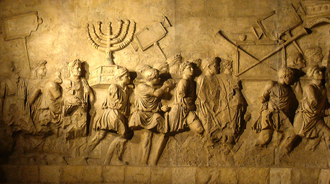
That got me to thinking about the nature of tradition. On the one hand, it can and does form a solid foundation upon which to build. On the other hand, it can just as easily become the proverbial Rock of Sisyphus that folks get tired of moving.

I think this has a lot to do with an emerging (no pun intended) idea that this post-Christian time period is much like the time after the destruction of the temple in Jerusalem in 70 A.D. We're in a post-establishment time and there is a huge temptation to metaphorically attempt to carry some of the foundation stones away from the now-destroyed temple in an attempt at reconstruction, or at least an attempt to hold onto a symbol of the way things used to be. Contrast that with Jesus' words about the temple that were read two Sundays ago:
Jesus answered them, "Destroy this temple, and in three days I will raise it up." The Jews then said, "This temple has been under construction for forty-six years, and will you raise it up in three days?" But he was speaking of the temple of his body." (John 2:18-21)
Jesus also famously said to his disciples, upon sending them out for the first time:
"You may take along a walking stick. But don't carry food or a traveling bag or any money. It's all right to wear sandals, but don't take along a change of clothes. When you are welcomed into a home, stay there until you leave that town. If any place won't welcome you or listen to your message, leave and shake the dust from your feet  as a warning to them." (Mark 6:8b-11)
I'm just beginning to unpack the metaphor of the similarities between post-temple Judaism and post-Christendom Christianity, but the lesson for us may be to be quite careful about what we choose to put in our "tradition packs." When I was a child, our family used to take backpacking trips regularly. When one backpacks, the object is to make things as light as possible, since you are going to be carrying anything you pack for many miles. So, things are re-packaged to minimize weight, one makes use of freeze-dried foods that are much lighter than regular food, and one is very careful about what sort of "extras" one takes--and things that seem critical in regular camping, not to mention around the house, rapidly become "extras" when one is forced to carry them for many miles on one's back!

Perhaps that is what we're doing these days in the church--we're packing for an ecclesiastical backpacking trip. We're trying to sort our the essentials from the extras--and sometimes finding out that things that seemed essential when we were in the comforts of Christendom have become extras now that we are packing for a trip into the ecclesiastical and spiritual wilderness. Perhaps we also need to unload and drop our temple building-stones and recall that Jesus is talking about himself when he says:
 "Then what do the Scriptures mean when they say, `The stone that the builders tossed aside is now the most important stone of all'? Anyone who stumbles over this stone will get hurt, and anyone it falls on will be smashed to pieces." (Luke 20:17b-18)
Pack carefully....

Tuesday, November 22, 2011

Fear and Leadership

In an organizational culture where respect and the dignity of individuals are held as the highest values, shame and blame don’t work as management styles. There is no leading by fear. --Brene Brown 
The above is just a portion of a brief, but excellent, blog post regarding the recent Penn State scandal. Her point is that any organization can create a culture that either fosters respect and accountability or fear and denial. Organizations that do the former are healthier, dynamic, and ultimately more successful organizations, though they are often not as outwardly peaceful as those that thrive on shame and blame. This is no less true of the church--churches where both staff and members actively engage in conversation with one another out of respect for "the dignity of every human being" (as our Baptismal Covenant says) may not look as peaceful or contented, but they are healthier, more dynamic places to be. Churches that enforce a kind of false peace based on shame and blame ultimately either slowly burn out or explode as individuals either take advantage of the system or our victimized by those who do.

There is a lot of fear around these days, both in the world and in the church. Both infrastructure and institutions built by previous generations seem to be disintegrating at an alarming rate. More and more people are feeling disenfranchised, cut off from any say in virtually any aspect of their lives. The Penn State scandal is but the latest in an unending parade of exposing the reality behind people and programs we thought we could trust. In a blog post by Thomas Day, he writes:
Think of the world our parents’ generation inherited. They inherited a country of boundless economic prosperity and the highest admiration overseas, produced by the hands of their mothers and fathers. They were safe. For most, they were endowed opportunities to succeed, to prosper, and build on their parents’ work. For those of us in our 20s and early 30s, this is not the world we are inheriting.

Day, at 31, was born in 1980, placing him on the cusp between Generation X and the Millennial generation. He lays the blame for this collapse on the leaders that the Baby Boomers have brought us--the logical extension of a generation that shunned institutions at the same time as they benefited from them. It is apparently our generation's sad duty to inform our children (millennials and those younger) that the American Dream is dead, the emperor has no clothes, and that the Great and Powerful Oz of the optimistic Boomer generation is no more than a lucky, grumpy old man.

Sadly, many people, both within and outside the church, leave things there--in despair, at Good Friday, if you will. But we repeat over and over again that we are "Easter people," not stuck in the tomb of death but partaking of resurrection life. That is not some sort of "put on a happy face" Christianity. No, it acknowledges the reality of death, but asserts that such is not the end of the story. The reality of resurrection means that we can take a hard, deep, penetrating look at the world around us, name clearly the things which are not right about it, and then partner with God in the redemption of our broken, disintegrating, world. The challenge, of course, is actually adopting and living into an attitude of "realistic optimism" that sees things for what they are, but also for what they should and can be. And we need leaders, both within and outside the church, who are willing to be foolish and risk-taking enough to move forward in hope rather than allowing us to linger in despair.

By the grace of God, may I be one of them!

Tuesday, October 11, 2011

"Uncle Steve" Jobs

Steve Jobs 1955-2011

Much has been said and written about Steve Jobs after his death this past Wednesday. Having never known him personally, never even having worked at Apple, the only connection I have to him is as an Apple customer and stockholder. That said, many of my contemporaries and I feel almost as if we've lost a beloved but distant uncle. Growing up in Silicon Valley, the legend of Apple's first first "run" with the Apple II and Macintosh is eclipsed only by the legend of the rebirth of Apple with the iMac, iPod, iPhone, and iPad. I was still a small child when Johs graduated from the high school just south of the one I would attend a decade later, but I hit middle school about the time the Apple II emerged and I well recall the sheer joy of using a computer with color, speed (for its time), and floppy disks rather than cassette tapes.

So, in many ways, Steve Jobs was the author of my childhood obsession with computers. Perhaps that is why I and others of my generation mourn his passing so much.  The passion he brought to technology, the conviction that technology not only could but would change the world, is one that he lived out with single-minded determination.

This is not to say that Jobs was a saint. At least one blogger has some very pointed criticism of him, much of it on target. He was often ruthless in his pursuit of excellence. His desire to see his biography published so that "my kids will know me better" signals that, like many in Silicon Valley, he had the tendency to prioritize job over family. However, his genius for designing technology that people could (and did) fall in love with is unmatched in modern-day America. His famous commencement address at Stanford University ranks among the best ever.

Though I didn't know him, I use Apple technology almost every minute of every day. I wake up to the alarm from my iPhone, check my calendar on that same iPhone, work every day on a MacBook Pro, use my iPad to watch videos and read books, and pretty much just love Apple products with a passion. I hope that I can increasingly take this passion and "can do" spirit into my job as a clergy leader as well.

Thursday, September 30, 2010

Visionary Leadership vs. Cult of Personality (updated)

UPDATE: I just ran across the following video presentation on Steve Jobs and Apple Computer. It has a lot to say about the cult of personality verses a culture of vision:


One of the things I struggle with in my own ministry is how proactive to be in my leadership. I've seen (mostly evangelical) churches where the pastor (or, sometimes, the pastor and his wife) are front and center in advertisements and promotional materials, and it is very clear that this is "Pastor X's Church." Among the many difficulties with that is that when the pastor moves on or, God forbid, has some moral failing, that loss has an incredibly huge impact on the congregation, much more so than it might if the pastor were just another staff member. How do you have Pastor X's Church without Pastor X? On the other side, it is quite clear that the pastor of any church has enormous impact in all areas of church life--spiritual, financial, programming, etc... Leadership does matter, and as much as we talk about delegating authority and broadening our leadership base, someone has to be the point person and say "We're going THERE!" Committees don't do that nearly as well as a single individual.

The other issue with a single leader versus a shared leadership model is the cognitive dissonance that people go through. On the one hand, people crave clarity and stability and so are often happy to follow a leader who is self-assured and at least appears to have a good grasp on things. On the other hand, there is a deep distrust in our country of people with any sort of power. We can see it at work in our national politics, with the warnings of people "taking over" or "ramming things through." We seem to be intellectually more comfortable with distributed power and shared leadership, but our hearts know what our brains often forget--there is no substitute for a clear vision and direction and a visionary leader to cast that vision and support it.

As we enter October, the church moves from the rush of the beginning of the program year to thinking about what is variously called stewardship season, the Fall Pledge Drive, or any number of other names. It is a time when we quite literally ask people to buy into a vision, to support it with both their money and their time. The more specific and compelling that vision is, presumably the easier it is to achieve such buy-in. Yet this is not my church, it is God's church and the congregation can do far more collectively than I can do individually. So we are back to the conundrum--do we make the pastor the focus in the interest of having a more focused vision or do we have a more distributed leadership in the interest of sharing power and inviting more participation? Like anything else, it is a delicate dance...

Sunday, June 06, 2010

Leader or Nutcase? Time and followers will tell...

I'm in the midst of a challenging period in my ministry. Challenging in a good way, but challenging nonetheless. The challenge is that I've gotten what I've prayed for--a parish eager to grow and knowing that there is a clear choice between growing and thriving or shrinking and dying. Many churches, though they say that they want to grow, are perfectly happy just the way they are. St. Edward's, thankfully, is not one of them.

That's not to say life is without difficulties. We're ending the time of transition between the former Rector's tenure and where we hope to be in the near future. This summer is a turning point, a tipping point, between the old St. Edward's and the new St. Edward's. As we end the transition and look towards the future, we also are spending money previously thought of as inviolate--walled off from being touched and, in some ways, a part f the parish's identity. We're having to let go of that identity a bit, without any real assurance about the future. To add to that, we're discovering as we go that, much like when one renovates a home, as we explore further we discover issues that need to be addressed, sometimes requiring more funding than originally anticipated. While I'm sure of our direction, such discoveries nevertheless give me pause.

My seminary classmate and Bishop of Texas, The Rt. Rev. C. Andrew Doyle (Andy to me) passed along the following to Episcopal Café. I think it is really an interesting commentary on leadership:


This was personally a revelation to me in a number of ways. The biggest is that it takes almost more courage to he a "first follower" than it does to be a leader. You can be a leader and be a nutcase. However, as a follower, you have the choice to follow or not to follow a given leader. Once someone gains a few followers, it is no longer about the leader.  I'd really like to get to that point, though we're still early in my time at St. Edward's. One challenge, of course, is that the priest is the identified leader and there is a continued differentiation between the priest and the lay leadership (vestry, ministry leaders, etc...) It is only when you get a large enough group to actually obscure the priest that such a person simply becomes nothing more than a rather specialized ministry leader. Food for thought about how I can become such a person.

Besides dancing with my shirt off, that is. No one wants to see that. Trust me.